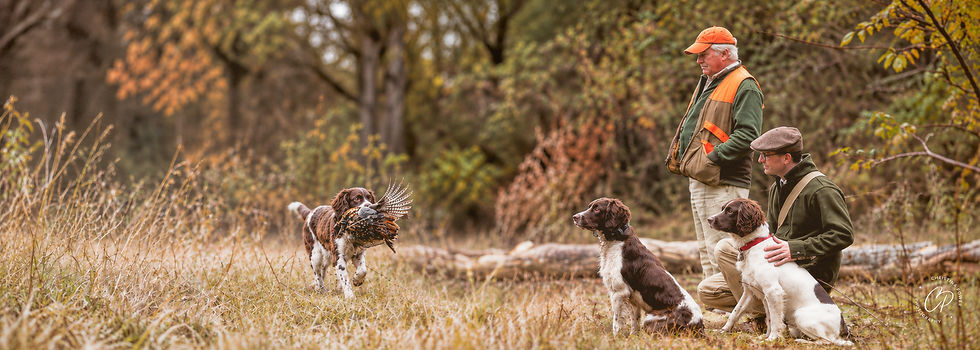
Riggins in the Grouse Woods: Training That Carries Over

A training field can show a dog the rules. The grouse woods ask whether the dog has understood them.
That is the distinction that matters in Riggins’ story. The day was not about a trainer managing every move from behind the dog. Joe was hunting and handling Riggins that day. Todd had trained Riggins. What made the work worth noticing was that the training held when the dog was in someone else’s hands, in wild cover, with real birds doing what wild birds do.
In grouse hunting with a gun dog, that is where much of the truth comes out.

The value of work that carries forward
Good training is not meant to make a dog dependent. It should give the dog enough structure to hunt with purpose when the situation grows untidy.
That can be a hard balance to strike. A dog needs to stay connected to the gun, take direction, respond to the whistle, and remain honest around game. Yet the same dog also has to use his nose, read the wind, and search likely cover without being nagged through every step.
In the training field, much of that can be shaped with care. A trainer can control the setup, set the standard, and repeat a lesson until the dog begins to understand it. The bird work can be clean. The ground can be chosen. Timing can be managed.
Wild grouse woods are different. They do not offer many clean repetitions. They give a dog scent that comes and goes, cover that pulls him off line, and birds that flush early, run ahead, or vanish altogether. A dog that looked neat in a field may look uncertain there. A dog with depth in his training begins to sort it out.
That was the interest in watching Riggins.
When the woods ask their own questions
Training a grouse dog is never only about obedience. Obedience matters, of course. Without it, there is no useful hunt. But the finest work comes when obedience and initiative live together in the same dog.
A spaniel in grouse cover has to hunt close enough to be useful, yet bold enough to reach the places where birds live. He has to push into cover that offers resistance. He has to quarter with intent, not merely run a pattern. He has to accept direction without losing his own sense of the hunt.
That is why wild bird dog training can never be judged only by what happens in a known field on a calm morning. At some stage, the work must meet the woods.

From the Grouse Woods
There are some things you simply cannot recreate in a training field.
The grouse woods have their own way of asking questions of a dog. The cover changes, the wind shifts, and wild birds rarely behave as expected. At some point, the dog has to begin making decisions for himself.
On this particular day, Joe was handling Riggins, a dog Todd had trained. There wasn’t a need for constant direction. Riggins stayed connected, hunted the cover and worked with the man carrying the gun.
For a trainer, there is something particularly satisfying in watching that happen. The training has left your hands, and the relationship between dog and hunter takes over.
Todd made a few notes from watching Riggins work that day.
That last point is easy to pass over, but it says much. A good trainer keeps watching after the formal work is done. Trying not to take over. Trying not to correct every decision from the edge of the cover. Simply to see what held, what matured, and what the dog now understands without being carried through it. Though there are times when standing back is far easier said than done.
The quiet signs of a finished lesson
A dog does not need to look dramatic to show that training has taken root. Often the signs are modest.
He casts into cover without being sent again and again. He checks back naturally. He turns with the gun instead of hunting for himself. He takes a whistle because the habit has become clear, not because pressure hangs over him. When scent changes, he works it rather than rushing past or freezing into confusion.
Those details matter in grouse woods dog training because most of the work happens out of full view. A handler sees a flash of the dog, a turn of the head, a tail working in cover, then nothing but brush moving. Trust fills the gaps. That trust is earned before the hunt, but it is proven during it.
For those who spend time around cocker spaniel grouse hunting, spaniel training, upland gun dog training, and the steady standards associated with Craney Hill Kennel, Riggins’ day is familiar in the best way. It is not a story of spectacle. It is a story of partnership.

The trainer’s satisfaction from the edge of the hunt
There is a particular satisfaction in seeing a trained dog go well for another handler. It may be the most honest measure of the work.
When the trainer is holding the whistle, the dog knows the voice, the habits, the timing, and the expectations. There is value in that relationship, but it can also hide a few things. A dog may be responding to the familiar shape of a person as much as to the lesson itself.
When another hunter takes the dog into wild cover, the lesson has to stand on its own. The dog must understand the work well enough to apply it in a slightly different partnership.
That does not mean the dog becomes mechanical. Quite the opposite. The best trained gun dogs are not machines. They are companions with judgment. They know the boundaries of the hunt, but inside those boundaries they use themselves.
That is what made the day with Riggins worth writing down. Joe was handling the dog. Riggins was hunting for Joe. Todd, having done the earlier work, could watch the training carry over into the kind of country that reveals what a dog really knows.

What Riggins showed in the cover
A day in the grouse woods does not need to produce a grand account to be remembered. Sometimes the better story is quieter.
Riggins showed that the work done before the season had meaning beyond the place where it was taught. He hunted cover with Joe. He stayed in touch. He made decisions in changing bird country without needing to be managed at every turn.
That is the aim of serious gun dog training. Not to create a dog that only performs under perfect conditions, or only for the trainer who shaped him, but to prepare a dog for the real exchange between hunter, cover, wind, bird, and shot.
The grouse woods asked their questions. Riggins answered them well.
Riggins has passed since then and he will always be close to our hearts. Riggins the wonky eyed cocker...


